Predicting What New Physics Will Look Like

Meet Andrea Thamm, 24, one of the up-and-coming physicists attending this year’s Lindau Nobel Laureate Meeting


Name: Andrea Thamm
Age: 24
Born: Rostock, Germany
Nationality: German
Current position: Ph.D. student at the Swiss Federal Institute of Technology Lausanne and CERN
Education: Master of physics with Honors Mathematical Physics from the University of Edinburgh
What is your field of research?
I am working in theoretical high-energy physics, more specifically on beyond the Standard Model phenomenology. We try to extend the current description of particle physics to describe the properties of the elementary particles more precisely, and we check what signatures these models would have in an experiment.
What drew you to physics, and to that research area in particular?
I am very fascinated by the way mathematical equations can explain nature, and I’ve always wanted to understand more. My topic is quite theoretical and needs relatively advanced mathematical concepts to describe the properties of the elementary particles and their interactions. However, it’s still close enough to reality and to nature to describe observables which can actually be measured and prove a theory right or wrong. I like the idea to learn and reveal more about the building blocks of nature.
Where do you see yourself in 10 years?
If I manage I would really like to continue doing research. The field is so broad and the learning process very slow and I really want to understand more. It’s an exciting time for high-energy physics since the LHC just started running and there are many years of data taking ahead. This will for sure shed new light on some long-standing fundamental questions and I would love to be part of it.
Who are your scientific heroes?
There are a few people who I admire for their curiosity, creativity and stamina. My very personal hero, however, is my granddad, who has worked in physics all his life with a never-ending enthusiasm to understand just a bit more about the world we live in. Over the years he developed a very broad knowledge and ability to tackle problems. I would be very happy if I can keep my enthusiasm just as he does.
What activities outside of physics do you most enjoy?
I have played the piano for 15 years. Right now, it’s not so easy to find the time and, more importantly, a piano, but I’m trying to play more again and come back to it. I love dancing and reading, writing and the sea.
What do you hope to gain from this year’s Lindau meeting?
The meeting provides a unique chance to meet so many Nobel laureates in such a stimulating environment. Not only will the opportunity to meet such successful personalities and to attend their lectures and seminars be very inspiring for my own research career, it will also open one’s eyes to a wide spectrum of open questions in many different areas of science. Besides the lectures and the scientific program, it will be a great opportunity to meet other young researchers from all over the world, to discuss and talk, learn about science, cultures and languages. It is always very motivating and a lot of fun to stay in such an enthusiastic environment, exchange ideas and find new friends.
Are there any Nobelists whom you are particularly excited to meet or learn from at Lindau?
Yes, I’m looking forward to meeting Martinus Veltman!

Working on Small Scales to Solve Huge Energy Challenges

Meet Vinamrita Singh, 25, one of the up-and-coming physicists attending this year’s Lindau Nobel Laureate Meeting

Name: Vinamrita Singh
Age: 25
Born: Haryana, India
Nationality: Indian
Current position: Ph.D. student, Department of Physics and Astrophysics, University of Delhi, India
Education: Bachelor’s degree, master’s degree from University College, Kurukshetra University, Haryana, India
What is your field of research?
The study of electrical and optical properties along with degradation and aging of organic bulk heterojunction photovoltaic devices.
What drew you to physics, and to that research area in particular?
Beginning my career as a processing geophysicist led me to closely observe and experience the oil and gas industry. During this period, I also witnessed the oil spill in the Gulf of Mexico. This close proximity with the business of non-renewable energy resources was the motivation behind my choice of research area, and led me into the field of renewable energy.
Where do you see yourself in 10 years?
I see myself continuing research even after 10 years. The way research requires one to think, hypothesize, experiment and then analyze the findings really inspires me. I have devoted two years to the study of organic solar cells, and while studying I feel that there is still a lot of potential in these devices in the future. I would like to further explore more possibilities in this field itself, and want to significantly contribute to the use of flexible solar cells on window panes, clothes and as paints.
Who are your scientific heroes?
René Descartes: He not only significantly contributed in mathematics, but his philosophy also interests me. Albert Einstein: He is one scientist who I find an all-rounder. Dr. A. P. J. Abdul Kalam, who has successfully played a role as a leading scientist and President of India.
If you had unlimited resources, what kind of research would you conduct?
My dream study is related to oceanography. The Earth is more than 75 percentwater, but only 1 percent of the oceans have been studied due to technological limits of going deep under water. If I get unlimited resources, I would like to work on the exploration of ocean beds and the different forms of life that exist down there.
What activities outside of physics do you most enjoy?
Some of my hobbies and interests are dancing, writing articles, photography, stick-figure animations and reading novels.
What do you hope to gain from this year’s Lindau meeting?
Getting to attend the Lindau conference will not only give me the opportunity to be up to date with the ongoing advancements in research, but will also direct my vision to various other possibilities through which I can add new dimensions to my research. Any session related to my area of interest would definitely be beneficial as I could gain new concepts and implement them in my work. I anticipate this to be an event for pure exchange of knowledge at an international level that would diversify the mindsets of young researchers to meet the growing demands of technological and scientific growth. It would be an achievement if I could distribute the gain of knowledge and techniques in our lab to other researchers around me. I would be very delighted to get the opportunity to hear the lectures and life experiences of Nobel laureates, which is a very rare and important chance.
Are there any Nobelists whom you are particularly excited to meet or learn from at Lindau?
I consider it to be a great opportunity to meet any of the Nobelists. In particular, I would like to meet Prof. Albert Fert because he is related to nanotechnology and in my work I make use of nanomaterials. I would also like to meet Prof. Paul Jozef Crutzen as his work on atmosphere and environmental studies is very crucial, especially when the world is getting more and more polluting due to an increase in greenhouse gas emissions.

A Multilingual Condensed Matter Theorist

Meet Simone Hamerla, 27, one of the up-and-coming physicists attending this year’s Lindau Nobel Laureate Meeting


Name: Simone Anke Hamerla
Age: 27
Born: Essen, Germany
Nationality: German
Current position: Ph.D. student, Technical University of Dortmund
Education: Prediploma, diploma from TU Dortmund
What is your field of research?
I am working in condensed matter theory in the field of strongly correlated electron systems. At present my work focuses on fermionic systems driven out of equilibrium by a quench, i.e. a sudden change in the intrinsic system parameters. I study the dynamics of the system after an interaction quench, where the interaction between the particles is suddenly switched on, by the use of a semi-analytical method.
What drew you to physics, and to that research area in particular?
I came to physics as I love solving puzzles and the idea that you can understand certain aspects of everyday life with your work. It is great that physics always provides puzzling observations that prove that you do not at all understand nature.
As non-equilibrium systems are in highly excited states, a description of their dynamics imposes totally new requirements on the theory, which aroused my interest in these setups.
Where do you see yourself in 10 years?
Within the next 10 years I hope to gain an insight in the processes which are relevant for the relaxation of systems out of equilibrium. One of my goals is to understand by which means the thermalization is influenced and by which method these processes are described best.
Who are your scientific heroes?
I cannot state a single name here as my scientific heroes are spread over the whole area of physics.
What activities outside of physics do you most enjoy?
Dancing (Latin); languages: German, English, French, Latin, Chinese and Japanese.
What do you hope to gain from this year’s Lindau meeting?
Due to its casual atmosphere the meeting represents a unique chance to get to know the personalities behind the greatest accomplishments in physics. In my opinion the meeting is the ideal platform to discuss their achievements, current problems and aspects which have to be considered when further pursuing our research.
On the other hand one meets young scientists from all over the world and different disciplines. I think with our different backgrounds we can inspire each other and gain a new insight on physics. Thus the meeting provides an ideal breeding ground for new ideas.
Are there any Nobelists whom you are particularly excited to meet or learn from at Lindau?
I am of course especially interested in meeting the Nobelists working in my field. There are for example Prof. Dr. Theodor W. Hänsch and Prof. Dr. William D. Phillipswho laid the foundation of experiments with ultracold atoms. Ultracold atoms are the perfect testbed for the non-equilibrium systems that I study.

A Passion for Early-Universe Cosmology and Epic Bike Trips

Meet Laurence Perreault Levasseur, 24, one of the up-and-coming physicists attending this year’s Lindau Nobel Laureate Meeting


Name: Laurence Perreault Levasseur
Age: 24
Born: Quebec City, Canada
Nationality: Canadian
Current position: Ph.D. student, University of Cambridge
Education: B.Sc. (Hons) and M.Sc. from McGill University
What is your field of research?
I am interested in early-universe cosmology, in particular in how the study of the earliest moments of the universe can give us a better insight about fundamental physics. My current research interests are focused on the mechanisms for generating the primordial fluctuations and on preheating/reheating. Recently I have also been interested in theories of modified gravity, such as Galileon theories, and their application to models of the early universe.
What drew you to physics, and to that research area in particular?
From as far back as I can remember, my favorite question of all has always been “why?”. An inextinguishable curiosity about the world around me, and a deep feeling of awe as I was discovering it, has always lived in me. I have always been fascinated by the mysteries of the universe, by the perfection and beauty of nature. Throughout my academic formation, I learnt that theoretical physics was the path I should take to seek answers to my questions. Very fast, my fascination for the origins of the universe and its enigmas have drawn me toward cosmology, in the hope of getting a deeper understanding of some of the most fundamental questions.
Where do you see yourself in 10 years?
I’d really love to have the opportunity to dedicate my time and energy to the branch of science that I am pursuing now. I’d like to be a full-time researcher at a research institution and be actively involved in research and also teaching. I also really hope that I can start an international program through which pure sciences could be spread to the parts of the world with less opportunities for such fields. I have started this path by taking part in a teaching abroad program this summer where I teach physics inflation and early universe cosmology to undergraduate students in developing parts of China. In the long term I hope I can motivate the scientific community to take united measures to actively spread and promote pure sciences to developing regions of the world.
Who are your scientific heroes?
Hubert Reeves has definitely had a lot of influence on me wanting to become a physicist during my teenage years. He is a now-retired nuclear physicist from Quebec who wrote a lot of popular science in French, and is very famous among French Canadians. Reading his books were definitely very inspiring and made me believe it was possible for someone like me to become a leader in science at the international level, if I was aiming far enough.
Marie Curie and Emmy Noether are also role models for me, first simply because they are females in a highly male-dominated field and opened many doors at a time when there were very few opportunities for women, and second because they are world-recognized experts who have had a gigantic impact in their respective fields and in science in a more general sense.
What activities outside of physics do you most enjoy?
I am an avid biker. I particularly like traveling with my bicycle, and usually I go for epic adventures. For my first journey, two of my friends and I went from Montreal to Florida in one month, for a total distance of about 3,000 kilometers, with nothing but three bicycles, a tent and camping material, little money, and a lot of enthusiasm. The year after I traveled in Italy for a summer school in Trieste and I brought my bike along. I went for day trips in Slovenia, and after the school I went from Bologna to Nice in France and back. Last year I went in biking in Belgium and Germany, and this year I will go around Portugal. My big and crazy dream is one day to travel from Paris to Beijing on my bike. We’ll see how that goes, and if I manage to do it before I turn 80 years old!
Apart from that, something a bit less extreme that I like to do is cooking. I love spending my Sunday afternoon making my own bread while listening to the radio (I am very old fashioned for that!), baking some banana cakes for my husband, preparing some good dishes for the week and trying lots of new recipes and tastes.
What do you hope to gain from this year’s Lindau meeting?
Throughout my career, I have learnt to appreciate the importance of collaboration in research, as well as the richness of international interactions. My first contact with advanced physics was through the International Summer School ISSYP (Perimeter Institute) in 2004, an experience through which I was exposed to first-class scientists and international researchers, giving me a chance to share my passion for science. This conference profoundly modeled my view of the scientific world.
Such conferences are precious opportunities for the larger scientific community to share cutting-edge scientific activities, discuss their vision and opinions about the general direction of the field, and make deep interpersonal connections which will lead to great long-term collaborations.
I have been privileged to have many opportunities to attend such conferences, which has resulted in productive international collaborations which I am a part of. From these unique exposures, I can assert how inspiring interactions with senior and fellow junior scientists are, which motivates me to attend the 2012 Lindau conference.
Are there any Nobelists whom you are particularly excited to meet or learn from at Lindau?
I am very excited to meet George Smoot and Brian Schmidt, because they are two cosmologists/astrophysicists/astronomers who have revolutionized the field of cosmology and contributed to shape it and define the questions we are striving to answer. I would really like to know their views on the future direction that this field of science should take in order to answer today’s fundamental questions in cosmology.

A Radio Astronomer Investigating Galaxy Evolution

Meet Jacinta Delhaize, 25, one of the up-and-coming physicists attending this year’s Lindau Nobel Laureate Meeting


Name: Jacinta Delhaize
Age: 25
Born: Perth, Western Australia
Nationality: Australian
Current position: Ph.D. student, University of Western Australia, International Centre of Radio Astronomy Research
Education: Bachelor of Science (Honours), University of Western Australia
What is your field of research?
I use large radio telescopes to study the evolution of galaxies in the universe.
What drew you to physics, and to that research area in particular?
I have always been fascinated by the beautiful photos produced by telescopes like Hubble. The more I learned about physics and maths, the more fascinated I became in what was going on in the pictures as it revealed a whole new aspect. I found it irresistible to discover more, and so I chose to study astrophysics.
Where do you see yourself in 10 years?
I would love to work with the Square Kilometer Array, a huge radio telescope array that will be built across Australia/New Zealand and Southern Africa. When it is completed in around 10 years’ time, it will have the capability to detect some of the first stars formed after the big bang.
Who are your scientific heroes?
One of my scientific heroes is Ruby Payne-Scott. She was the first female radio astronomer in Australia and she was a very intelligent and inspirational lady. This year we celebrated what would have been her 100th birthday.
What activities outside of physics do you most enjoy?
I have been doing ballet since I was about 6 years old and more recently have also taken up swing dancing.
What do you hope to gain from this year’s Lindau meeting?
The motto of the Lindau Nobel Laureate Meetings is “Educating, inspiring, connecting scientific generations.” These are precisely the ways that I hope this exciting meeting will contribute to my life and career. The Nobel laureates are the best possible people to inspire and advise my generation, and it will be a great privilege to interact with them and learn from their wisdom. The meeting will also be a unique opportunity to network with students from different countries and disciplines to make new, valuable friends and colleagues.
Are there any Nobelists whom you are particularly excited to meet or learn from at Lindau?
I am very excited to learn from the three attending laureates who also work in the field of astrophysics and galaxy evolution. These are Brian Schmidt, an Australian astrophysicist who shared the Nobel Prize in 2011 for discovering the accelerating expansion of the universe, and George Smoot and John Mather, who shared the prize for their characterization of the cosmic microwave background.

A World-Traveling Scholar of Nanophotonics

Meet Marina Radulaski, 26, one of the up-and-coming physicists attending this year’s Lindau Nobel Laureate Meeting


Name: Marina Radulaski
Age: 26
Born: Belgrade, Serbia
Nationality: Serbian
Current position: Ph.D. student, Stanford University
Education: Bachelor’s degree in physics from the University of Belgrade; bachelor’s degree in computer science from Union University, Serbia
What is your field of research?
My area of research is nanophotonics, more specifically, nonlinear optics in photonic crystal cavities.
What drew you to physics, and to that research area in particular?
I started learning about quantum physics at high school science camps. My intuition was challenged by the concepts of macroscopic superposition, photon entanglement and quantum computing. This led to a lot of reading and discussions, which kept me eager to understand quantum aspects of nature. Studying how light behaves in tiny volumes is in line with this curiosity, and I expect to see exciting new physics arising from our field.
Where do you see yourself in 10 years?
It is my passion to teach people to think critically and creatively, because I recognize these skills as formative for a progressive society. I can see myself achieving this as a professor through a direct contact with students, or as a policymaker, affecting a large number of people through various educational platforms.
Who are your scientific heroes?
Richard Feynman for his character and out-of-the-box thinking, and Anton Zeilinger for asking and answering intriguing philosophical questions in quantum physics.
What activities outside of physics do you most enjoy?
I like science popularization and own a modest collection of science toys. I enjoy dancing Cuban salsa and Argentinian tango, as well as pursuing my passion for travel, which has taken me to over 20 countries during my studies.
What do you hope to gain from this year’s Lindau meeting?
I am very honored to have been invited to the Lindau meeting and am looking forward to interacting with the Nobel Laureates in person. I would especially like to learn about the steps that led to their biggest discoveries, the roads they had to take before getting on the right path, as well as about the predictability of the significant results before they were obtained. I am also interested to hear about the topics the Nobelists are involved with now and what they see as critical for the science to progress. Finally, I hope they could give us advice on how to continue our scientific career.
Are there any Nobelists whom you are particularly excited to meet or learn from at Lindau?
I am looking forward to meeting Laureates who have set grounds to the modern optics research: Prof. [Theodor] Hänsch, Prof. [Roy] Glauber, Prof. [John] Hall and Prof. [William] Phillips.

Working Toward Ultrafast Nanoscale Optical Devices

Meet Martina Abb, 29, one of the up-and-coming physicists attending this year’s Lindau Nobel Laureate Meeting

The annual Lindau Nobel Laureate Meeting brings a wealth of scientific minds to the shores of Germany’s Lake Constance. Every summer at Lindau, dozens of Nobel Prize winners exchange ideas with hundreds of young researchers from around the world. Whereas the Nobelists are the marquee names, the younger contingent is an accomplished group in its own right. In advance of this year’s meeting, which focuses on physics, we are profiling several promising attendees under the age of 30. 
Name: Martina Abb
Age: 29
Born: Friedrichshafen, Germany
Nationality: German
Current position: Research fellow at the School of Physics & Astronomy, University of Southampton
Education: Master of Science (Diploma) from the University of Heidelberg, Germany (2009);
PhD from the University of Southampton, UK (June 2012)
What is your field of research?
I am working on nonlinear control of plasmonic nanostructures. That means that we investigate the electron gas oscillations that occur in metal nanoparticles and how they can be manipulated on ultrafast time scales. Ultimately, the holy grail is to develop nanoscale ultrafast optical devices for integrated photonic circuits.
What drew you to physics, and to that research area in particular?
What drew me to physics in general was always the challenge of exploring and understanding new ideas. What drew me towards the field of research I am currently involved in is both its versatility and its applicability. For my Master’s thesis, I was doing purely theoretical work, which was very interesting as well – but I wasn’t comfortable just working at a desk all day. During my thesis and now in my first postdoc, I have a very good mixture of all aspects of research projects. I enjoy both doing nanofabrication in the clean rooms, the simulations and exchange of ideas and finally, the table-top optics experiments that need to be designed and built. That way, if you’re stuck on one aspect, you can go and do something else for a while to clear your head.

Where do you see yourself in 10 years?
In 10 years, I hope to have significantly contributed to my chosen fields of research. It would be fantastic to achieve seizable ultrafast signal modulation with nanooptical components.
Most importantly of all, though, I hope that I’ll still be as enthusiastic about physics in general and plasmonics in particular, and that research will still be as much fun!

Who are your scientific heroes?
My scientific heroes – that is a difficult question. I don’t like to choose historical personalities for that, because, even if they have achieved or discovered great things, I don’t know them personally and I wouldn’t want to glorify someone I might not agree with on other levels. Rather, I look among my colleagues and collaborators who tackle scientific difficulties everyday and are not deterred by all kinds of small obstacles such as bureaucratic issues. They are the real scientific heroes, I believe.
What activities outside of physics do you most enjoy?
I read a lot in my free time, but never any physics books. I quite enjoy doing sports; my recent passion being squash, which I play 2-3 times a week. I also do quite a bit of outreach, like going to schools with our department’s laser light show to get children of all ages interested in physics.
What do you hope to gain from this year’s Lindau meeting?
There’s many things I hope to gain from the Lindau meeting. For one thing, it will be great to meet so many other young researchers from all over the world who work on so many different topics. I think that will give me a whole new perspective – even at bigger physics conferences, you normally only get a quite specific range of topics. For example, I never meet particle physicists at any of the conferences I go to. On the other hand, I’m looking forward to hearing all the big names give their talks and master classes, of course!
Are there any Nobelists whom you are particularly excited to meet or learn from at Lindau?
Albert Fert and William Phillips are the two names that come to my mind at once, since I am incredibly impressed by their work. Looking at the program, I am very much looking forward to Peter Gruenberg’s talk on “An introduction to the Harmonies of Alpine Folklore Music with Live Examples” – that should be interesting!

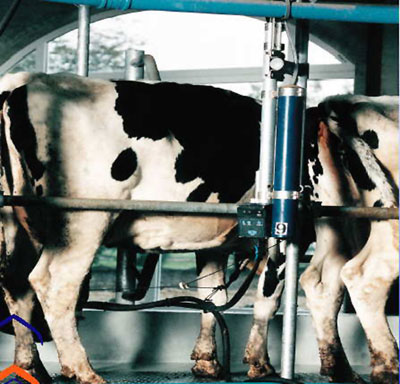
El robot de ordeño

Desde hace muchos años, la agricultura suiza está ampliamente mecanizada. Y la producción de leche no ha quedado al margen de esta evolución. 


El robot de ordeño no convence a todo el mundo. Este nuevo descubrimiento de la robotica, sin embargo, ofrece muchas ventajas, tanto para los animales como para los ganaderos. 


A continuación podemos ver un interesante vídeo en YouTube de la familia Cotting , en Suiza, donde muestra como hace su trabajo de ordenar a las vacas.


Para mayor detalle sobre este tema se puede revisar el siguiente enlace:
http://en.wikipedia.org/wiki/Dairy#Milking_machines

Historia de los transistores y Norman Krim

Norman Krim fue un visionario de la electrónica que jugó un papel fundamental en la transición de la industria de la válvula electrónica de vacío, de gran tamano, que una vez se alinearon en las entrañas de radios y televisores, al transistor pequeño, mucho más potente.


(Norman falleció  en diciembre del 2011, a los 98, por una insuficiencia cardíaca congestiva)


El Sr. Krim,  hizo varios descubrimientos en una larga carrera con la compañía Raytheon y  tuvo participacion en el crecimiento de la cadena de RadioShack. No inventó el transistor. (Tres científicos lo hicieron, en 1947, en los Laboratorios Bell.)

Pero él vio el potencial del dispositivo y convenció a su empresa para comenzar a fabricarlo a gran escala, especialmente para su uso en los audífonos en miniatura que él había diseñado. Al igual que el viejo tubo, un transistor es un semiconductor que amplifica las señales de audio.


La revista Time escribió en 1953:

“This little device, a single speck of germanium, is smaller than a paper clip and works perfectly at one-tenth the power needed by the smallest vacuum tube. Today, much of Raytheon’s transistor output goes to America’s hearing aid industry.” (Germanium, a relatively rare metal, was the predecessor to silicon in transistors.)

Traduccion:
 «Este pequeño dispositivo, una solo grano de germanio, es más pequeño que un clip y funciona a la perfección a una décima parte de la potencia necesaria por el tubo de vacio más pequeño. Hoy en día, gran parte de salida de transistor de Raytheon va a la industria de Estados Unidos del audífono. «(Germanio, un metal relativamente raro, fue el predecesor de silicio en los transistores.)


Eso fue sólo el comienzo. «Ahora hay más de 50 millones de transistores en un chip de computadora sola, y miles de millones de transistores se fabrican todos los días», dijo Jack Ward, curador del Museo del transistor en línea, en una entrevista. «Norma era el primero en reconocer el potencial y la llevó Raytheon para ser el primer fabricante mas importante de transistores».


Miles de discapacitados auditivos de personas se beneficiaron del uso inicial del señor Krim del transistor en los audífonos compactos. Pero no todos los transistores Raytheon eran conveniente para ellos.

«Cuando los transistores fueron los primeros en ser fabricado por Raytheon en una escala comercial, se produjo un proceso por lotes denominado CK722s que eran demasiado ruidosos para su uso en aparatos auditivos,» dijo Harry Goldstein, un editor de IEEE Spectrum, la revista del Instituto de Ingenieros Eléctricos y Electrónicos Ingenieros.


Así que el Sr. Krim en contacto con editores de revistas como «Popular Science» y Electrónica de radio comenzó a comercializar los CK722s a los aficionados.

«El resultado fue que toda una generación de aspirantes a ingenieros – los niños, en realidad, trabajando en sus garajes y sótanos – tiene que hacer todo tipo de proyectos electrónicos», dijo Goldstein, entre ellos las radios a transistores, amplificadores de guitarra, los osciladores de código, Geiger contadores y detectores de metales.»


El señor Ward llamó al Sr. Krim «el padre de la CK722».

Antes de que aparezca el transistor, el Sr. Krim ya había hecho contribuciones significativas a la industria. En 1938 dirigió un equipo de Raytheon que se desarrolló tubos de vacío en miniatura para su uso en radios de batería. 


Norman Bernard Krim nació en Manhattan el 3 de junio de 1913, uno de los cuatro hijos de Abraham y Krim Ida.Después de graduarse de la escuela secundaria George Washington a los 16 años, fue aceptado en el Instituto de Tecnología de Massachusetts, donde en su primer año construyó un «cerebro eléctrico» que, según artículos de prensa de la época, parecía ser capaz de tomar decisiones infantiles , decidir si prefiere la remolacha o espinacas, por ejemplo.


La empresa Raytheon contrat  a Norman Krim después de su graduación en 1934, a 50 centavos la hora. En el momento en que dejó la compañía en 1961, fue vicepresidente de la división de semiconductores.


Después de salir de Raytheon, el Sr. Krim compró dos tiendas de electrónica en Boston. En el momento en que él vendió el negocio a la Corporación Tandy. Dos años más tarde, tenía siete tiendas, hoy en día la cadena tiene cerca de 7,300.

El Sr. Krim fue un consultor de marketing de Raytheon y otras empresas hasta el año 1997.

Fuente: NYT, Dennis Hevesi, 20 Diciembre del 2011

Un nuevo planeta en el sistema solar

Científicos sugieren que los llamados mundos solitarios, que vagan errantes por el espacio interestelar, pueden acabar «capturados» por una estrella


Los científicos han descubierto recientemente un nuevo tipo de planetas que parecen flotar en solitario en el espacio. Se trata de los llamados mundos errantes, que, alejados de cualquier estrella, vagan por el espacio interestelar después de haber sido expulsados de los sistemas planetarios en los que se formaron. Ahora, una nueva investigación del Centro Harvard-Smithsoniano de Astrofísica sugiere que estos mundos nómadas pueden encontrar un nuevo hogar con un sol diferente. Incluso afirma que miles de millones de estrellas en nuestra galaxia pueden haber capturado planetas errantes. Este hallazgo, que aparecerá publicado en la revista especializada The Astrophysical Journal podría explicar la existencia de algunos planetas que orbitan sorprendentemente lejos de sus estrellas, e incluso la existencia de un sistema de doble planeta.

Para llegar a esta conclusión, los investigadores simularon grupos de estrellas jóvenes que contienen planetas que flotan libremente. Descubrieron que si el número de planetas errantes iguala el número de estrellas, del 3 al 6% de las estrellas terminarían por atraer uno de estos mundos a su sistema. Cuanto más masiva es una estrella, más posibilidades tiene de enganchar a un nuevo compañero.

Los expertos estudiaron cúmulos de estrellas jóvenes, porque la captura es más probable cuando las estrellas y los planetas que flotan libremente se apiñan en un espacio pequeño. Con el tiempo, los grupos se dispersan debido a la estrecha interacción entre sus estrellas.

Los planetas errantes son una consecuencia natural de la formación de estrellas. Los sistemas de estrellas recién nacidos a menudo contienen múltiples planetas. Si dos planetas interactúan, uno puede ser expulsado y convertirse en un viajero interestelar. Si más tarde se encuentra con una estrella diferente moviéndose en la misma dirección y a la misma velocidad, puede quedar «enganchado» en el paseo.

Un planeta capturado tiende a situarse cientos o miles de veces más lejos de su estrella de lo que la Tierra está del Sol. También es probable que tenga una órbita inclinada con respecto a los planetas nativos, e incluso puede girar alrededor de su estrella hacia atrás.
Un mundo más allá de Plutón

Los astrónomos todavía no han detectado casos claros de los planetas capturados, que pueden ser fácilmente confundidos. Encontrar un planeta en una órbita distante alrededor de una estrella de poca masa sería una buena señal, porque el disco de la estrella no habría tenido suficiente material para formar el planeta tan lejos.

La mejor evidencia encontrada hasta la fecha proviene del Observatorio Europeo Austral, que anunció en 2006 el descubrimiento de dos planetas (con un peso de 14 y 7 veces Júpiter) que orbitan entre sí, sin una estrella. Pero, ¿podría nuestro sistema solar albergar un mundo extraño mucho más allá de Plutón? Los astrónomos lo han buscado y no han encontrado nada todavía. «No hay evidencia de que el Sol haya capturado un planeta», apunta el investigador Hagai Perets, uno de los responsables del estudio. «Podemos descartar grandes planetas, pero hay una posibilidad distinta de cero de que un pequeño mundo pueda estar al acecho en la periferia de nuestro sistema solar», matiza.


*ABC-Ciencia, Madrid, 18 abril 2012